
Introduction
Choosing the right hosting type is one of the first and most important decisions when launching a website or web application. Two of the most common options are cloud hosting and shared hosting, each designed for different needs, budgets, and technical requirements. Understanding how they differ will help you select the solution that best supports your goals.
What Is Cloud Hosting?
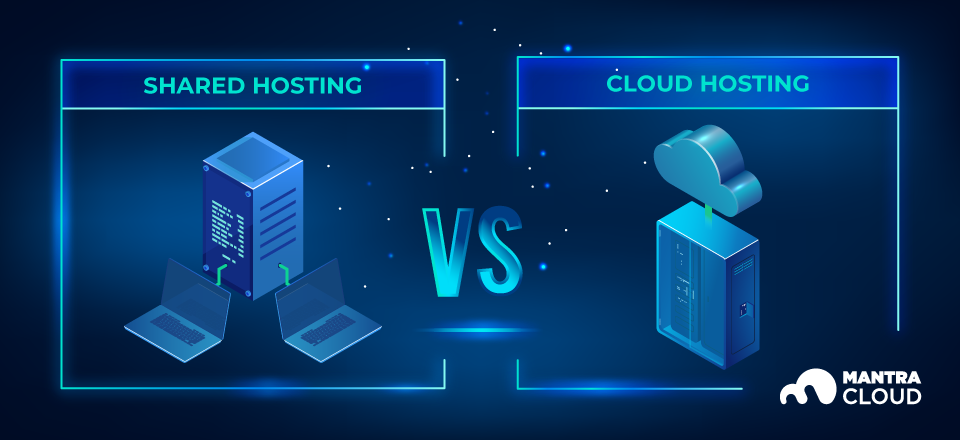
Cloud hosting distributes your website across multiple interconnected servers that work together as a cluster. This architecture balances the load across the cluster and provides built-in redundancy. If one server in the cluster experiences a hardware failure or becomes overloaded, another server automatically takes over, ensuring your website remains accessible. Resources can be scaled dynamically based on real-time demand, making cloud hosting inherently flexible and resilient.
What Is Shared Hosting?
Shared hosting places multiple websites on a single physical server, with all sites sharing the same pool of CPU, RAM, storage, and bandwidth. Each account receives a limited allocation of resources to prevent any single site from monopolizing the server. This approach keeps costs low and requires minimal technical knowledge, making it the most popular entry point for new website owners.
7 Key Differences
1. Server Resources
Cloud hosting pools resources from multiple servers, giving your website access to a large and flexible resource pool. If your site needs more CPU or memory during a traffic spike, the cloud infrastructure can allocate additional resources from other servers in the cluster.
Shared hosting divides the resources of a single physical server among all hosted websites. Each site receives a fixed allocation, and there is no mechanism to borrow additional resources. If the server becomes overloaded, all sites on it may experience performance degradation.
2. Scalability
Cloud hosting excels at scalability. Resources can be added or removed quickly, often with just a configuration change or automatically through auto-scaling rules. This makes cloud hosting ideal for growing businesses, seasonal traffic patterns, and applications with unpredictable demand.
Shared hosting offers very limited scalability. Upgrading resources typically means migrating to a larger shared plan or moving to a different hosting type entirely. Shared hosting is not well-suited for websites that expect significant growth.
3. Performance
Cloud hosting delivers more consistent and reliable performance, especially under heavy load. The distributed architecture means traffic spikes on your site can be absorbed across multiple servers. Advanced caching, CDN integration, and optimized server configurations are often standard features.
Shared hosting performance is directly affected by the activity of other websites on the same server. During peak periods, resource contention can lead to slower page loads, timeouts, and degraded user experience for all sites on the server.
4. Security
Cloud hosting provides stronger security isolation. Each account typically operates in its own virtual environment, and a security compromise on one site does not directly threaten others. Cloud providers generally offer advanced security features including DDoS protection, Web Application Firewalls (WAFs), automated backups, and granular access controls.
Shared hosting presents a higher security risk because all sites share the same server environment. If one website on the server has a vulnerability that gets exploited, it can potentially affect other sites. While providers implement server-level security measures, the shared nature of the environment limits the level of isolation possible.
5. Technical Requirements
Shared hosting is designed for ease of use. Providers typically offer intuitive control panels (like cPanel or Plesk) that handle most server management tasks through a graphical interface. No command-line or system administration skills are required.
Cloud hosting generally requires more technical knowledge to configure and manage effectively. However, many providers now offer managed cloud hosting plans that handle the technical complexity for you, making cloud hosting accessible to users without advanced system administration skills.
6. Support
Support quality varies significantly between providers regardless of hosting type. However, cloud hosting plans typically come with higher tiers of support, including faster response times, more knowledgeable engineers, and proactive monitoring. Shared hosting support tends to be more basic, focused on common issues and general guidance.
7. Cost
Shared hosting is the most affordable hosting option, with plans often available for just a few dollars per month. This makes it accessible for personal projects, blogs, and small business websites operating on tight budgets.
Cloud hosting costs more, but pricing is typically based on actual resource consumption. You pay for what you use, which can be more cost-effective than paying for fixed resources that may go underutilized. For businesses with variable traffic, cloud hosting’s pay-as-you-go model can provide better value.
Which Should You Choose?
Choose Shared Hosting If:
- You are launching a personal blog or small website with modest traffic.
- Budget is your primary concern and you need the lowest possible cost.
- You have limited technical knowledge and want simple server management.
- Your website does not handle sensitive financial or personal data.
Choose Cloud Hosting If:
- You run an e-commerce store or business application that needs high reliability.
- Your website experiences variable or growing traffic patterns.
- Security and data protection are top priorities.
- You need the ability to scale resources up or down quickly.
- Downtime would have a significant financial or reputational impact.
Conclusion
Both cloud hosting and shared hosting serve important roles in the hosting landscape. Shared hosting provides an affordable and accessible starting point for simple websites and personal projects. Cloud hosting delivers the performance, security, scalability, and reliability that growing businesses and critical applications demand. The right choice depends on your specific requirements, technical capabilities, and growth trajectory. For e-commerce sites, business applications, and any project where uptime and performance are essential, cloud hosting is the stronger investment.